Lentils are a vegan's best friend. They are tasty, versatile, filling, fast-cooking, and hella-cheap. I've done a lot of things with lentils in my 6 years of veganism, and tonight I'm sharing one of my favourites. No big surprise, it's a soup. Dal, to be exact. Now in India, "dal" is the word for any legumes (lentils, peas and beans) that have been hulled or split. Dal can also refer to a preparation of legumes, as a stew or soup. Hulled lentils and split peas break down when you cook them, which is perfect for making thick, stick to your ribs soups.
Now, I have to confess something. I hate peas. Peas of all kinds. Most of all, I hate yellow split peas. Pea soup? Grossest food on the planet. I know, not very vegan of me. But I know that they are super good for you, so I've put them in this soup, and maybe, little by little, I can teach myself to like them. I've kept my pea-to-lentil ratio low, but if you like peas, by all means, add more!
As discussed above, it is important to use hulled lentils in order to get the right texture. Red lentils will do the trick and easy to find in most grocery stores, but any other hulled lentil will do.
Vegan Masoor Dal
1 onion, minced
3 cloves garlic, minced
1 carrot, shredded or finely chopped
3-4 kale leaves, finely chopped
1 tsp turmeric
1/2 tsp each cumin, garam masala, & cayenne pepper (to start)
1 1/2 cups red lentils
1/2 cup split yellow peas
5 cups vegetable broth
Mince up your veggies and saute in a pot with a bit of oil. Save yourself some time and mince up your veggies in a food processor if you have one. Add the rest of the ingredients and simmer until the lentils are cooked. Taste the soup, and add more spices to taste. Serve with papadams or vegan naan bread if you can find it (most naan has dairy in it, but I've found vegan ones at the grocery store before).
Showing posts with label soup. Show all posts
Tuesday, November 5, 2013
Monday, October 3, 2011
Brrr!
Well it's October. Don't ask me how it happened, I haven't a clue. It's summer, everyone is warm and happy, you look away for one second and BAM! cold, damp, fall swoops in to put an end to sundress season. Wasn't it only last weekend that I was sweating my butt off hiking through Gatineau Park on a beautiful 25 degree day? Yep. That was definitely only 8 days ago. Regardless of what evil trickery brought it about, it's here now, and we're just going to have to deal with it. Autumn has arrived, and that means it's time to bust out the jackets and scarves, and it's also time to start making soup.
The really great thing about autumn (or as I like to call it "soup season") is that the fall harvest brings a bounty of produce to the local farmers markets. So many soup possibilities await! All of the produce in this warming, immune-system-boosting soup can be found at the farmers markets now. You can make this in two ways: soup or stew. I'll tell you how I made the soup, then what you can do differently to make it a stew instead!
Vegan Groundnut Soup
Makes about 2 big meal-sized servings, or 4 small "on the side with a sandwich" sized servings
1 onion, diced
2-3 cloves garlic, minced
1 tsp fresh ground ginger
1 red pepper, chopped
4 plum tomatoes, diced
1-2 sweet potatoes, cubed (1-2 cm cubes)
Enough vegetable broth to just cover the vegetables
Cayenne pepper to taste
1/4 cup peanut butter (all-natural preferred)
In a large pot, saute onions with a bit of oil for a few minutes until they soften. Add in garlic and ginger and saute for one minute. Add the tomatoes and red peppers and saute until tomatoes start to break down.
Add remaining ingredients making sure to only put as much vegetable broth in as is needed to cook the sweet potatoes - you can add more liquid later, but it's more difficult to take it away. Bring to a boil and simmer until sweet potatoes are cooked.
Using a hand blender, pulse soup to form a thick, creamy base while still leaving lots of chunks of vegetables. Alternatively, you can remove 1/3 to 1/2 of the soup and puree in a blender, then return it to the remaining soup. Add more liquid if needed to reach desired soup density.
Stew form: Chop vegetables into larger chunks, do not puree at the end, and serve over rice. Top with chopped peanuts and cilantro. You may also add beans, tofu, or faux chicken to this stew if it pleases you.
| Lookout view over Gatineau park, Sept. 25 - the leaves just starting to turn |
The really great thing about autumn (or as I like to call it "soup season") is that the fall harvest brings a bounty of produce to the local farmers markets. So many soup possibilities await! All of the produce in this warming, immune-system-boosting soup can be found at the farmers markets now. You can make this in two ways: soup or stew. I'll tell you how I made the soup, then what you can do differently to make it a stew instead!
Vegan Groundnut Soup
Makes about 2 big meal-sized servings, or 4 small "on the side with a sandwich" sized servings
1 onion, diced
2-3 cloves garlic, minced
1 tsp fresh ground ginger
1 red pepper, chopped
4 plum tomatoes, diced
1-2 sweet potatoes, cubed (1-2 cm cubes)
Enough vegetable broth to just cover the vegetables
Cayenne pepper to taste
1/4 cup peanut butter (all-natural preferred)
In a large pot, saute onions with a bit of oil for a few minutes until they soften. Add in garlic and ginger and saute for one minute. Add the tomatoes and red peppers and saute until tomatoes start to break down.
Add remaining ingredients making sure to only put as much vegetable broth in as is needed to cook the sweet potatoes - you can add more liquid later, but it's more difficult to take it away. Bring to a boil and simmer until sweet potatoes are cooked.
Using a hand blender, pulse soup to form a thick, creamy base while still leaving lots of chunks of vegetables. Alternatively, you can remove 1/3 to 1/2 of the soup and puree in a blender, then return it to the remaining soup. Add more liquid if needed to reach desired soup density.
Stew form: Chop vegetables into larger chunks, do not puree at the end, and serve over rice. Top with chopped peanuts and cilantro. You may also add beans, tofu, or faux chicken to this stew if it pleases you.
Thursday, November 4, 2010
Squash-travaganza!
Let's talk about squash. I love squash. All kinds of squash, even the sport! Squash squash squash!
Squashes belong to the family Cucurbitaceae which includes such wonderful fruits as melons, gourds and cucumbers. There is a huge variety of squashes, including pumpkin, zucchini, butternut, acorn, hubbard, cushaw, buttercup, sweet dumpling, celebration, cream of the crop, sweet mama, turban, spaghetti, delicata, heart of gold.... and still more that I haven't heard of yet.
Although there are so many varieties, they belong to only four species: Cucurbita maxima (hubbard squashes), C. mixta (cushaw), C. moshata (butternut squash), and C. pepo (pumpkins, zucchini, acorn squash).
Squash were domesticated in Mexico eight to ten thousand years ago [1]. They were an important food staple in central and north america. Native Americans know squash as one of the "Three Sisters", along with corn and beans. The three crops were planted together - the corn stalk was used to support the bean vine, and the large squash leaves trapped moisture in the ground for the growing plants and inhibits the growth of weeds. Incidentally, combined together, squash, beans and corn make an excellent "Three Sisters soup".
There are many ways that I like to use squash. Have a sweet tooth? Try these totally awesome chewy pumpkin oatmeal cookies. They're my all time favourite cookie and I have yet to meet someone who doesn't love them. Zucchini is awesome sliced, seasoned, and roasted in the oven or grilled on the barbecue (or campfire!). Acorn squashes and their kin are perfect cut in half, roasted in the oven, with a little margarine and brown sugar sprinkled inside. Butternut squash is my favourite for making fantastic (and filling) soups.
Basic Butternut Squash Soup
1 onion, diced
1-2 tbsp margerine
1 Butternut squash, peeled & cubed
Water
vegetable bouillon cubes
Nutmeg, cinnamon & allspice, a few good dashes of each
Maple syrup for drizzle (optional, but awesome)
Saute onion in margarine until caramelized. Toss in the squash and add enough water to just cover the squash. *Tip: measure your water as you're pouring it in so you know how many bouillon cubes to add!* Add your bouillon cubes and spices, and bring to a boil. Let it simmer until the squash cubes are soft. Puree the soup with a hand blender. If you're using a regular blender, make sure you vent the lid and cover it with a cloth so it doesn't create a pressure build-up and burst hot steam/soup in your face. Nobody wants to be burned by squash. At this point the soup could be pretty darn thick, so add some water, a little at a time. I like to be conservative with my water during cooking because you can always add more but it's so much harder to take it away if you've added too much! When you get the soup to the desired consistency, ladle some in a bowl and swirl a drizzle of real maple syrup on top, perhaps grate a little nutmeg on there. Not only does it taste delish, it makes it look extra snazzy!
| Sweet dumpling and acorn squash |
| Celebration, Cream of the Crop, and Heart of Gold squash |
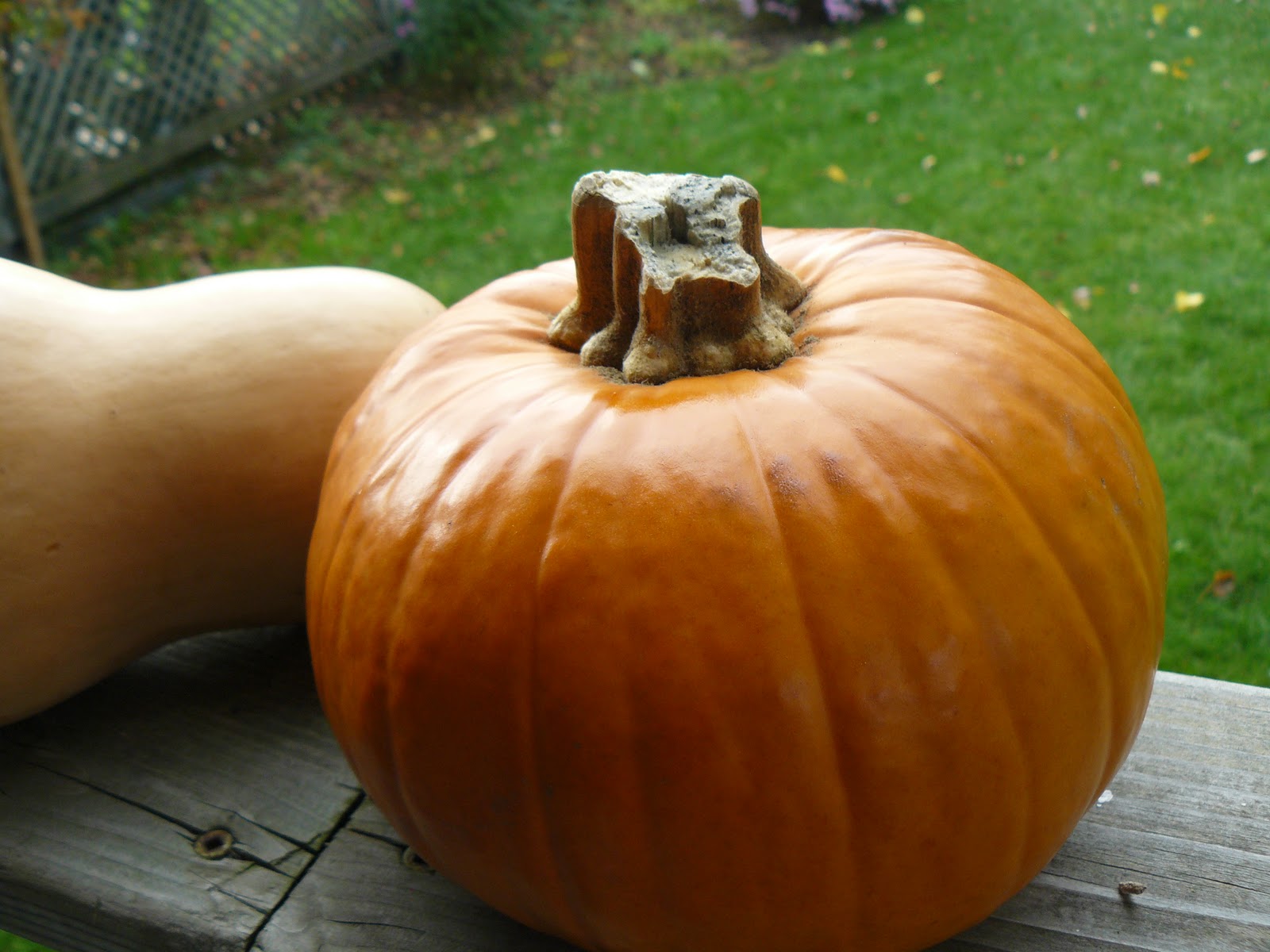
| Butternut squash and pie pumpkin |
| Oven-roasted Sweet Dumpling squash with Sweet & Savory Quinoa |
| Butternut squash soup with maple syrup drizzle (and my cat Skrabble!) |
1 onion, diced
1-2 tbsp margerine
1 Butternut squash, peeled & cubed
Water
vegetable bouillon cubes
Nutmeg, cinnamon & allspice, a few good dashes of each
Maple syrup for drizzle (optional, but awesome)
Saute onion in margarine until caramelized. Toss in the squash and add enough water to just cover the squash. *Tip: measure your water as you're pouring it in so you know how many bouillon cubes to add!* Add your bouillon cubes and spices, and bring to a boil. Let it simmer until the squash cubes are soft. Puree the soup with a hand blender. If you're using a regular blender, make sure you vent the lid and cover it with a cloth so it doesn't create a pressure build-up and burst hot steam/soup in your face. Nobody wants to be burned by squash. At this point the soup could be pretty darn thick, so add some water, a little at a time. I like to be conservative with my water during cooking because you can always add more but it's so much harder to take it away if you've added too much! When you get the soup to the desired consistency, ladle some in a bowl and swirl a drizzle of real maple syrup on top, perhaps grate a little nutmeg on there. Not only does it taste delish, it makes it look extra snazzy!
Monday, February 15, 2010
More Thai Peanutty Goodness
My spicy Thai peanut dressing from last night put me in mind of spicy peanut dipping sauce, and my favourite thing to dip in that sauce is Thai fresh rolls (aka summer rolls). They are crunchy, fresh (as the name
suggests), snazzy looking and super easy. If you want to wow a date or dinner party, whip up some of these babies. They can be made up to a day ahead if you store them covered with a damp cloth (don't use terrycloth, the little loops and fluffs will stick to the wrappers), but they're such a snap to make, I would just get all my veggies sliced ahead of time and assemble right before serving.
The other great thing is that fresh rolls are easy to make only as much as you want at the time, with one exception - the noodles. Fresh rolls usually contain rice noodles, which usually come in bundles fit to feed a family of four, and are impossible to separate into smaller bunches without getting dry noodles in every corner of your kitchen, only to linger there and poke your bare feet for weeks afterward even though you've swept the floor several times. I may be speaking from experience. An excellent option is to plan your meals around noodles. The cooked noodles store well in the fridge and you can use them the next day for a noodley stir-fry, or in a delicious soup like the one I made tonight with my fresh rolls.
Thai Fresh Rolls
Makes as many as you want!
-slivered veggies such as peppers, carrots, cucumber, green onion, sprouts, avocado
-cooked & cooled rice noodles
-rice papers
Cook your noodles according to the package directions. When they're cooked, pour them out into a colander and rinse well with cold water til the noodles are totally cold. Slice all your veggies and have them ready. If you're using avocado, brush them with a little lemon juice to keep them from browning.
*Alternatively you can skip the noodles and it can be rolled up in lettuce or other flexible leafy green leaf for a truly raw dish.*
Spicy Peanut Dipping Sauce
This will make enough for about 4 rolls
1 tbsp peanut butter
1 tbsp soy sauce
1 tsp brown sugar
1/2 tsp grated fresh ginger
1/2 clove garlic minced
Hot sauce or chili flakes (optional)
1-2 tbsp water to give desired sauce consistency
Stir ferociously til well blended and smooth.
The soup I made with this meal has pretty typical Asian elements and would go well with any type of meal, or all by itself as a quick lunch. The nori sheets in this recipe impart the flavour of the sea, as soups from Japan, Vietnam, Thailand and the like often are made with fish broth or other fish/seafood flavourings. You can leave it out if you're not partial to the flavour of nori. This soup is also very adaptable - you can add any number of vegetables you want. I think shredded carrot, peppers, and sprouts would be wonderful additions. Tiny cubes of tofu would also be great in this soup, and make it a more complete meal. I've given you the basics, and my personal favourite way of preparing it, it is now yours to personalize.
Super Easy Asian Noodle Soup
Makes 1 big bowl
4 or 5 shiitake mushrooms, sliced
1 clove garlic, minced
1/2 tsp fresh grated ginger
1 tbsp soy sauce
2 cups vegetable broth
1/2 tsp chili flakes (optional)
1 strip* toasted nori, broken into small pieces
1 green onion, sliced
1 baby bok choy, chopped
handful of cooked rice noodles*
In a hot pot, saute shiitakes, garlic, and ginger with soy sauce for a few minutes. Add vegetable broth, chili flakes and nori. *Nori is often perforated into about 6 or 8 strips, use only one of these strips, NOT a whole sheet. Let the broth simmer for about 5 minutes to let the flavours mingle. Remove from heat and add onion, bok choy and rice noodles. *If you happen to have single serving rice noodle "nests" add them in a few minutes before removing from heat. Serve in a big bowl.
Sunday, February 7, 2010
"It is a mistake to think you can solve any major problems just with potatoes" - Douglas Adams
As a Canadian and descendant of some collection of Celts and Brits, I am obliged to adore the potato. And really, why wouldn't I? It is delicious, worldly, versatile, and surprisingly good for you! Proponents of the Atkins diet and other equally foolish anti-carb schools of thought have made an enemy of the potato, but it will always be an ally in my kitchen. An average sized potato has about 4 grams of protein, nearly no fat, almost half your recommended daily intake of vitamin C, and they're a good source of thiamine, niacin, vitamin B6, magnesium and iron. Bet you didn't know this beige tuber was as good for you as it is delicious, did you?
More than just delicious and nutritious, the potato has been an important part of history and has shaped our society in ways many of us do not realize. Potatoes were domesticated in Peru between 3000 and 2000 BC. They grew thousands of varieties of potato, though much of this diversity has never been experienced by the "first world". Spanish explorers brought the potato back to Europe in the 1500s, where it became one of the most important food crops. Potatoes helped save Spanish sailors from scurvy due to their high vitamin C content. It was a staple crop in the 18th century among peasants, a fact that would forever change history.
Factoid: The 'bottleneck effect' occurs after a die-off, migration or other such event where a small proportion of the population is left to carry on or create a new population, which is left genetically impoverished due to the loss of genetic diversity in the gene pool.
Because European potatoes lacked the genetic diversity that the Andean potatoes possessed, they were more susceptible to disease, such as the fungus Phytophthora infestans, which lead to the Great Irish Potato famine that you've most likely all heard of. It is estimated that over 1 million deaths can be attributed to the potato famine in Ireland, while around 1 million more emigrated from Ireland around this time due to the famine and other hardships, most of whom came to Canada and the United states. In the 1851 census it was revealed that over half the population of Toronto was Irish. In Statistics Canada's 2006 census, 14% of Canadians claimed to have Irish ancestry, no doubt thanks to the potato.
So I, like many of my fellow North Americans, owe my very existence and current circumstance to the unfortunate ills of the 19th century Irish people. And what better way to honour such an important food than by putting it in a soup? One of the things I love about soup is that it is possible to make a delicious home-cooked meal with minimal ingredients, dishes, and time.
Easiest Ever Potato Soup
Serves 1
1 Medium potato, skin on, diced
1/4 onion, diced
2 cloves garlic, minced
1 cup vegetable broth
Salt & Pepper
In a pot sauté onion and garlic til soft. Add diced potatoes and broth. Tip: the smaller you dice the potatoes, the faster they will cook! Bring to a boil and simmer til potatoes are soft. Blend and serve topped with some freshly ground pepper.
Saturday, January 23, 2010
Just Beet It: Cook Red-Handed
"The beet is the most intense of vegetables. The radish, admittedly, is more feverish, but the fire of the radish is a cold fire, the fire of discontent, not of passion. Tomatoes are lusty enough, yet there runs through tomatoes an undercurrent of frivolity. Beets are deadly serious." - Tom Robbins
I used to hate beets, or so I thought. As it turns out, I hated the way my mom used to make them - boiled and mashed with mayo. Not exactly appetizing eh? It wasn't my mom's fault, she had never had them any other way.
I was always dismayed that I did not like beets, after all, they are quite good for you. The pigment that gives beets their beautiful colour is called betacyanin, and it is a potent cancer fighter. They also protect against heart disease and reduce inflammation. Beets are an excellent source of folate, which is essential for normal spinal cord development in fetuses. Without enough folate in the mother's diet, birth defects can occur. All around, beets are our friends.
Factoid: Some people are unable to break down betacyanin resulting in bright red urine after eating beets, so if this happens to you, don't be alarmed!
One day while at a salad bar, I spotted some pickled beets. Feeling adventurous, I put a few slices on my plate, returned to my table, and took a tentative bite. I was surprised to find that not only was I not spitting it out in disgust, but in fact, found myself wishing I had picked up more than two slices. They were really good!
It was several months after my revelation before I attempted to make beets for myself. I decided to play it safe and put them in a salad, to be featured in next week's Salad Challenge! This week, however, I was feeling bolder. Bold enough to try some new recipes, even, recipes that have in the past frightened me. One such recipe is Borscht.
Borscht is a traditional Ukrainian soup, popular throughout eastern Europe. With beets as their key ingredient, it has a characteristic deep red colour. It is a classic, iconic dish, and a must-try for a soup enthusiast such as myself. So after scouring the internet and cookbooks, I came up with my own version of Borscht.
Beetiful Borscht
1 beet, peeled & grated
1 carrot, peeled & grated
1 medium potato, peeled & diced
1 1/2 cups shredded cabbage
1/2 onion, diced
1 clove garlic
2 cups vegetable broth
2 cups water
1 roma tomato, diced
2 tbsp tomato paste
1 tbsp parsley
In your soup pot, saute onion and garlic in a bit of olive oil until soft. Add all other ingredients. Simmer until everything is happy, bright red, and soft. Many recipes I came across called for topping it with some sour cream and dill, so if you have any vegan sour cream like substance, toss a dollop on top, and sprinkle on some dill for an elegant colour contrast.
And the verdict? I actually quite liked it! Despite it's bold appearance, the flavour of the soup is quite unassuming. As it turns out, the beet's bark is bolder than its bite. It wasn't one of my favourite soups, but I will definitely make it again!
Monday, September 14, 2009
A hot cure for the cold
September is back to school season. While this makes many people think of school supplies and a new fall wardrobe, this time of year makes me think of sniffley-nosed freshmen and all the germs they are sharing. I am the furthest thing from a germaphobe and I almost never get sick, but I still like to fill my diet with immunity boosting ingredients just in case.
It is common knowledge that vitamin C plays an important role in maintaining immune function, but did you also know that carotenoids, specifically beta-carotene, is just as important. Beta-carotene is a powerful antioxidant, and it is also broken down in our digestive system into vitamin A. Though most well known for its role in vision, vitamin A helps us stay healthy in a number of ways. It boosts white blood cell function, increases antibody response, and most importantly, maintains healthy epithelial and mucosal tissues that serve as the bodies first line of defense against would-be intruders.
The red pepper is your best friend during cold season, and that's because one cup packs in a whole day's intake of vitamin A, and a whopping three times the amount of your recommended daily intake of vitamin C.
Factoid: Cooking destroys a lot of vitamin C. After 10-20 minutes of cooking, as little as 1/3 of the vitamin C found in the raw fruit may be left. So when cooking with vitamin C rich foods, look for ones, like red peppers, with 3 times more than you need!
A diet full of carotenoids and vitamin C can reduce your risk of cancer, and will certainly reduce your risk of colds. Carotenoids are typically found in orangey fruits and vegetables such as sweet potatoes, carrots, red and orange peppers, squash, tomatoes and mangoes, but it is also found in some unexpected places like spinach and collard greens. Try to make these foods a part of your daily life to keep you healthy.
Maybe you've done your best and already come down with the sniffles, or like me, ragweed season is still dragging on and your sinuses are more congested than the Gardiner Expressway during rush hour. That's why I've added a little bit of heat to today's cold-busting recipe. Capsaicin is the chemical in peppers responsible for their heat. Ever noticed how eating spicy foods cause your nose to run? That's because capsaicin stimulates the mucous membranes in your sinuses, which relieves congestion faster than any medicine on the market. In fact there are now a number of capsaicin based decongestant sprays now available. To top it all off, capsaicin can also reduce inflammation, and is a thermogenic, meaning it will cause your body to burn off more calories. All good reasons to spring for a little extra spice.
And as if those weren't good enough reasons, what is better than soup during cold and flu season?
Immunity Soup
1 large sweet potato
1 red bell pepper
1 medium hot pepper (I used the "Crimson Hot" variety)
1/2 an onion
1 clove of garlic
2-3 cups vegetable broth
Update: Add 1/4 cup of red lentils to give this soup a protein boost!
Chop all the veggies and combine all ingredients in a pot. Bring to a boil and simmer until soft (about a half hour). Puree and serve topped with fresh ground pepper.
P.S. All the produce in this recipe is currently in season in Ontario, so find a roadside stand or farmers market and go local!
Thursday, September 3, 2009
"Only the pure of heart can make good soup" - Beethoven
Although I am a die-hard summer fan, there is one thing that I look forward to with the coming chill in the air - soup season!! Living in Canada one has to find a silver lining in our seemingly endless winters. Some people play hockey, others ski, but not me. I make soup.
Though the weather has once again warmed, it's too late, I've caught the soup bug. Lucky for me, this early start to soup season has coincided with end of summer produce harvest, the makings of very delicious soup to be sure! The last time I was at the farmer's market I picked up some celery, then foolishly picked some up at the grocery store on Monday. With all this extra celery I just had to make a celery soup.
"Canada is the essence of not being. Not English, not American, it is the mathematic of not being. And a subtle flavour - we're more like celery as a flavour. " - Mike Myers
Celery's flavour may be subtle, but it is also a lovely flavour, that, with a little encouragement, can add great depth to a soup. I simply adore celery. My uncle despises it and I think he's crazy. It belongs to the family Umbelliferae (or Apiaceae, depending on your preference), a family that also includes carrots, and savory spices such as caraway, fennel, dill, parsley and cilantro. Not only is celery delicious, but very healthy. With only 10 calories per 100 grams, it is a guilt free source of vitamin C, calcium, fiber, and iron. It is a food that has been with us for ages. In the eighth century BC, Homer wrote in the second book of The Iliad: "Their horses stood each by his own chariot, champing lotus and wild celery." Lucky horses.
Celery Soup
Makes 1 serving - double, triple or quadruple if you're cooking for more than yourself!
3 stalks celery, chopped
1/4 cup chopped onion
1 clove garlic, chopped
1/4 tsp celery seed
3 mini potatoes, or 1 smallish potato, chopped
1 1/2 cups veggie stock
Saute celery and onion until softened. Add garlic and celery seed and saute 1 minute more. Add potatoes and stock, bring to a boil, then reduce and simmer until potatoes are softened. Puree with a hand blender (or transfer carefully into a normal blender). Top with some freshly ground pepper, and a celery leaf if you want a little extra somethin-somethin.
Factoid: Celery seed should be avoided by pregnant women as it stimulates the uterus and is rumored promote miscarriage!!
I ate this with a toasted mock tuna salad sandwich (which I made using only 2 spoonfuls of veganaise, I totally agree with Lindy Loo that 1/4 cup is way too much). They paired very well and made for a satisfying and healthy dinner.
Subscribe to:
Posts (Atom)